The Sword & the Teacup: Strength Tempered by Grace
Entry No. 31
Dear Faithful Companion,
Since time immemorial, the officer’s commission has not merely signified authority—but responsibility. Not brute command, but composed leadership. And it is here, in this sacred balancing act, that the soul of the officer-gentleman is forged.
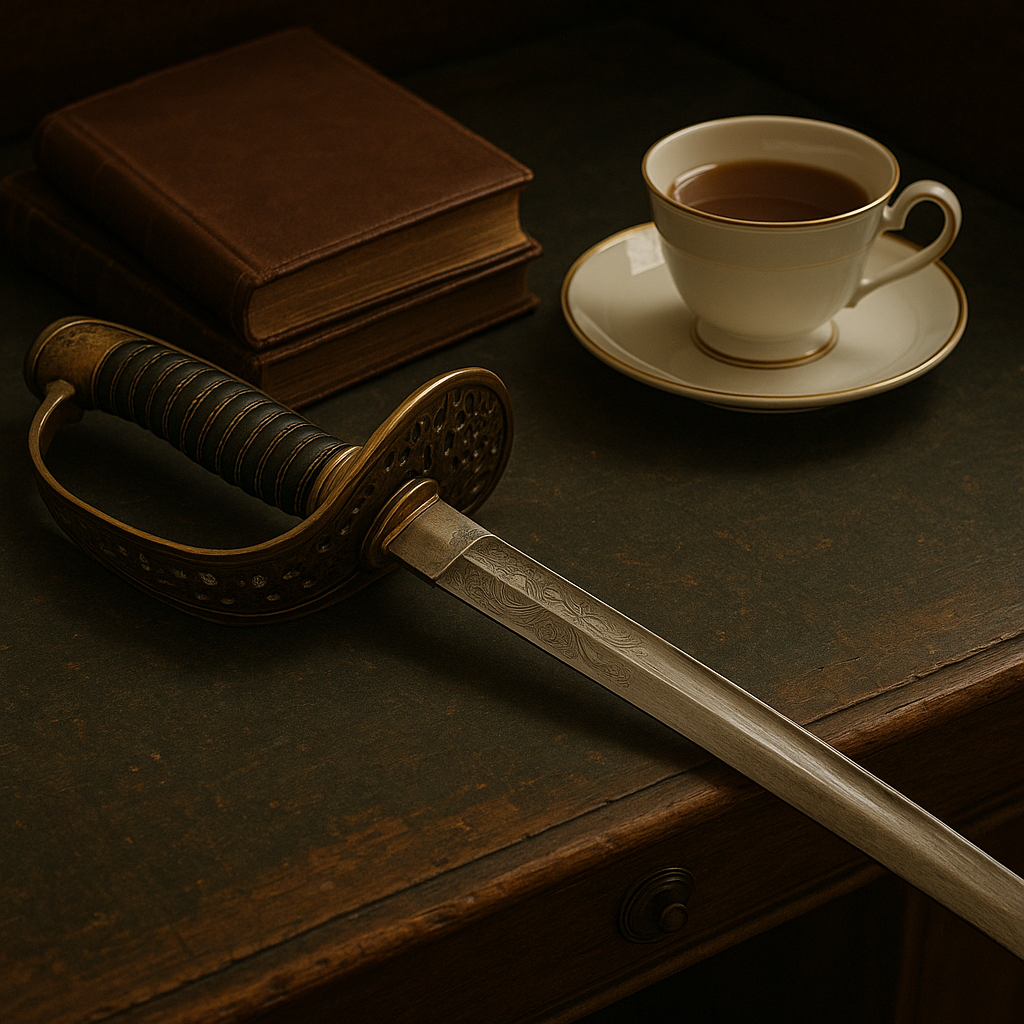
It is a curious truth of the military life that those entrusted with the tools of command must also master the art of gentility. The sword and the teacup may seem strange bedfellows—but I have come to believe that the true measure of an officer lies in the ability to hold both with equal poise.
Throughout my career, I have been tested not only in moments of operational stress or strategic pressure, but in the quiet corridors where mentorship lives and corrective action takes shape. To discipline a subordinate is no small act; it is a sacred responsibility. One must safeguard the integrity of the service while ensuring that the individual under scrutiny is not diminished, but rather forged anew—leaving the encounter not broken, but built. It is not enough to be right; one must also be just.
I recall one instance early in my commission when I had to counsel a junior member whose lapse in judgment could have cost them dearly. It would have been easy to reprimand and move on. But instead, I paused. I chose to teach rather than condemn. We sat, we talked, and together we rebuilt their standing—not only in the eyes of the institution, but in their own. Years later, that same individual would thank me—not for the correction, but for the dignity with which it was delivered.
But not all defining moments come in times of failure. I once observed a developing leader take initiative well beyond their rank, handling a delicate personnel matter with both maturity and discretion. I made a point to pull them aside—not merely to offer praise, but to ensure they understood why it mattered. A kind word, when earned and precisely given, can do more to strengthen a growing leader than a dozen directives. In both correction and commendation, the role remains the same: shape the individual, not just the outcome.
That moment left an impression. Yet even now, years later, I still find myself wrestling with these choices. There are times when the demand for swift justice clouds the opportunity to teach. But the lesson, I’ve found, is this: one must slow it down. Take a breath. Step outside the heat of the moment and step into the shoes of the person you lead. Leadership is not a race to judgement—it is a stewardship of potential.
Some of the greatest lessons I’ve absorbed came not through doing, but through observing—witnessing moments of integrity, poise, or failure in others. Whether inspiring or cautionary, these impressions left their mark. And perhaps more than anything, it has been the presence of thoughtful, seasoned mentors—those who wished to see me succeed—that has shaped me. Not all mentors stay for a lifetime; some walk beside us for only a season, offering their wisdom, their steadiness, and their clarity of thought before stepping back. But their influence endures.
In these reflective moments, I often turn to The Daily Stoic, which rests permanently on my desk. Thumbed and worn, it offers me no orders—only reminders. Reminders that leadership begins with self-governance, that composure is not the absence of force but its finest expression. When days grow heavy, I turn its pages and find clarity once more.
In this regard, I remain a student of Marcus Aurelius. “You have power over your mind—not outside events. Realize this, and you will find strength.” These words guide me more than any policy manual ever could. I think too of Wellington—stoic on the field, refined in the drawing room—and of our own General Sir Arthur Currie, who bore command with both intellect and empathy. Currie was not only a strategist but a symbol: proof that a Canadian officer could be both feared in battle and admired in character. As he once said: “Thorough preparation must lead to success. Neglect nothing.” In today’s Canadian Armed Forces, such leadership must also carry the modern weight of moral clarity, inclusive direction, and institutional integrity. Command today is not only about effectiveness—it is about trust.
And so I continue. I strive daily to embody both fortitude and finesse. The role of the officer-gentleman is not a static achievement but a lifelong endeavour—an aspiration shaped by self-awareness, refined by reflection, and tested in the crucible of command.
To those who walk this path after me: know this. You are not expected to know everything. But you are expected to listen, to learn, and to better yourself daily. Excellence is not an accident—it is a posture.
Verbum Ultimum
To the young officer: You now bear more than a rank. You wear the legacy of those who came before—and the hopes of those yet to serve.
Your bearing must be as sharp as your sword, your judgement as precise as your dress, your tone as measured as your step.
In the field: be resolute. In the mess: be gracious. In private: be principled.
Lead as though every moment is being watched— because one day, it will be remembered. Not all leadership is seen. Not all influence is loud. But all of it matters.
The sword may win battles. But it is the teacup—ritual, refinement, restraint—that earns trust and leaves legacy. Be both.
Until next we meet, with ink as my witness and virtue as my guide.
JCB