


“Before a book carried a barcode, it sometimes carried something far more personal — the mark of the library it called home.”

A bookplate — or ex libris — is more than a simple mark of ownership. It is a small declaration of identity: a meeting place of art, heraldry, personal history and the culture of the private library. Often no larger than a hand, a bookplate can preserve a remarkable amount about the person, family or institution for whom it was created.
Over the centuries, bookplates have reflected changing artistic tastes, engraving traditions and heraldic styles. Some are restrained and scholarly; others are richly armorial, incorporating crests, badges, mottos, orders and personal devices. Together, they offer a fascinating record of how individuals chose to identify themselves through the books they owned.
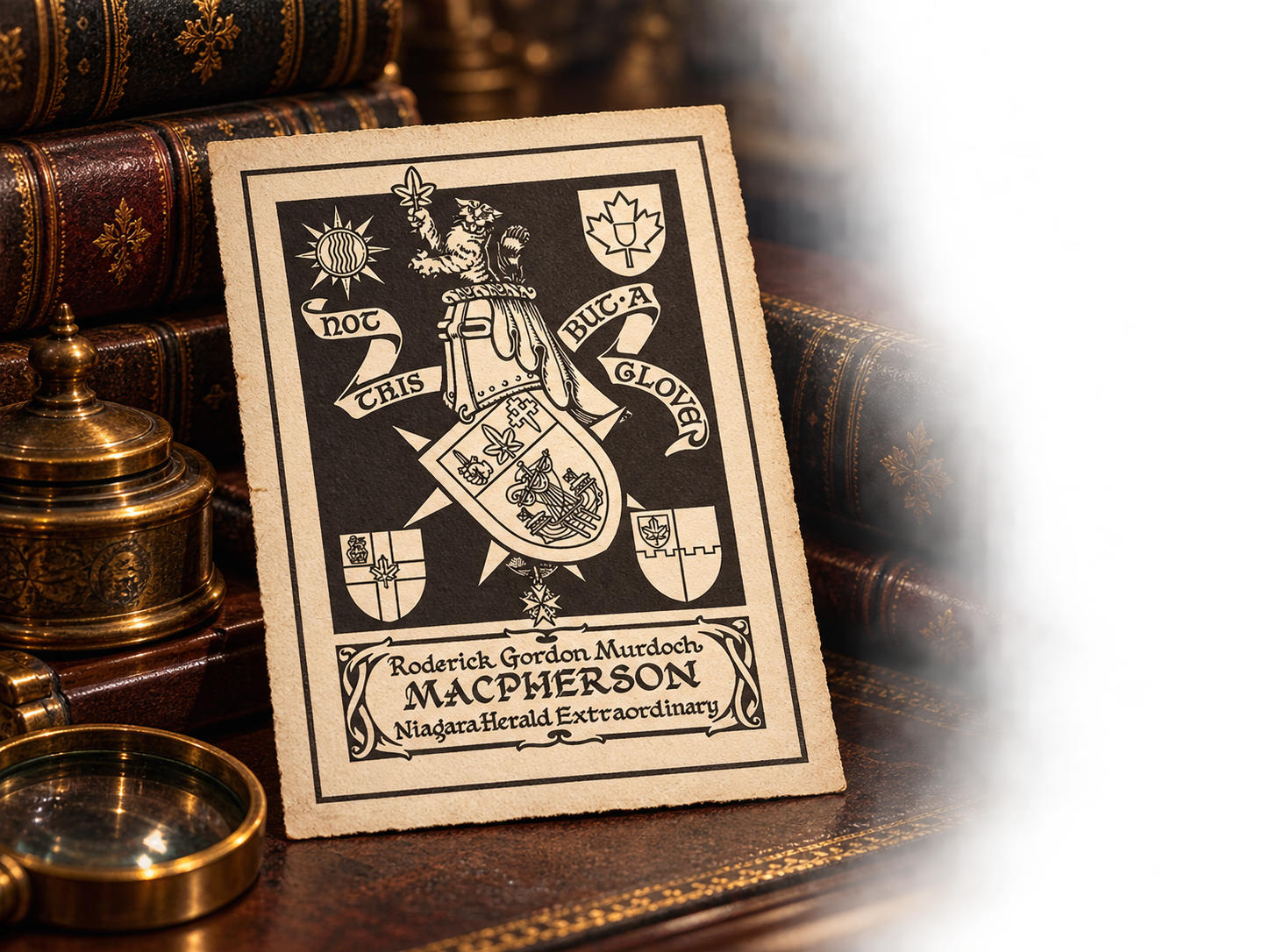
This collection brings together examples from several periods and countries, with particular attention to heraldic bookplates and to the Canadian tradition. Among its most significant holdings are more than 120 original bookplates designed by the Canadian heraldic artist R. Gordon Macpherson.
Each surviving plate is a small object, but often carries a much larger story — of ownership, identity, provenance and the library in which it once belonged.
Images are presented here for study and appreciation from examples held within the collection. Please do not reproduce or republish them without permission.
The Macpherson Collection

A Signiant holding within the collection, devoted to the bookplate work of R. Gordon Macpherson.
R. Gordon Macpherson &
The Canadian Heraldic Tradition
Among the most significant holdings within my collection is a substantial body of bookplates designed by Roderick Gordon Macpherson, CM, KStJ, FRHSC, FRSA, FSA Scot, late Niagara Herald Extraordinary and one of the defining figures in modern Canadian heraldic art.
Macpherson possessed a remarkable ability to reduce the complexity of heraldry to the intimate scale of the bookplate without diminishing either its dignity or its meaning. His work is distinguished by disciplined draughtsmanship, confident heraldic composition and an unmistakable sense of proportion. Created for individuals, families and institutions in Canada and abroad, these small works offer a fascinating record of both his artistic hand and the development of a distinctly Canadian heraldic tradition.
My interest in Gordon’s work is also deeply personal. He was a friend, mentor and trusted source of counsel during my formative years in heraldry. His generosity with his knowledge helped shape my own understanding of the subject, and during the development of my armorial bearings through the Canadian Heraldic Authority, he became a valued confidant with whom ideas, designs and possibilities could be freely explored. Our shared appreciation for heraldic bookplates was one of many interests that connected us over the years.
What began as an admiration for his work gradually became a collection in its own right. Today, the Macpherson Collection comprises more than 120 original examples of his bookplate designs, representing individuals and institutions from across Canada and beyond.
Only a selection is presented here. Together, however, these plates offer a glimpse into a much larger body of work — one that I am privileged to preserve not simply as examples of accomplished heraldic art, but as part of the legacy of a man whose friendship, knowledge and influence remain deeply valued.
R. Gordon Macpherson, CM, KStJ, FRHSC, FRSA, FSA Scot
Niagara Herald Extraordinary and heraldic artist associated with the Canadian Heraldic
The University of Trinity College
An institutional bookplate for the historic federated college of the University of Toronto.
Rideau Hall
Bookplate for the official residence and workplace of the Governor General of Canada.
Dr. Gordon L. Good
Historian, heraldist and Fellow of the Royal Heraldry Society of Canada.
Robert D. Watt, LVO
First Chief Herald of Canada and later Rideau Herald Emeritus.
The Honourable Hilary M. Weston, CM, CVO, OOnt
Twenty-sixth Lieutenant Governor of Ontario.
Mrs. Nancy Macpherson
A personal bookplate created for the wife of Gordon Macpherson.
Captain(N) Thomas C. Pullen, OC, CD, Distinguished Canadian Arctic navigator and explorer.
Dr. Claire Boudreau
Second Chief Herald of Canada and Margaree-Chéticamp Herald Emeritus
The Right Honourable Roméo LeBlanc, PC, CC, CMM, ONB
Twenty-fifth Governor General of Canada.
LCdr Alan Beddoe, OC, OBE
Heraldic artist, designer of Canada’s Books of Remembrance, and first president of the RHSC
HCol Allan B. Bird, CStJ, CD, FRHSC
Former president of the Heraldry Society of Canada and Honorary of The Brockville Rifles.
The Right Reverend Ralph Spence
Former Bishop of Niagara and Albion Herald Extraordinary.
Colonel John Ross Matheson, OC, CD, QC
Parliamentarian and heraldist who played a central role in the development of Canada’s National Flag.
The Hospital for Sick Children
An institutional bookplate for Toronto’s renowned children’s hospital.
James Macintosh McCready
New Zealand heraldist, scholar and prolific artist whose work included numerous bookplates.
Contemporary Armorial Bookplates
Artists, Heraldists & the Living Tradition
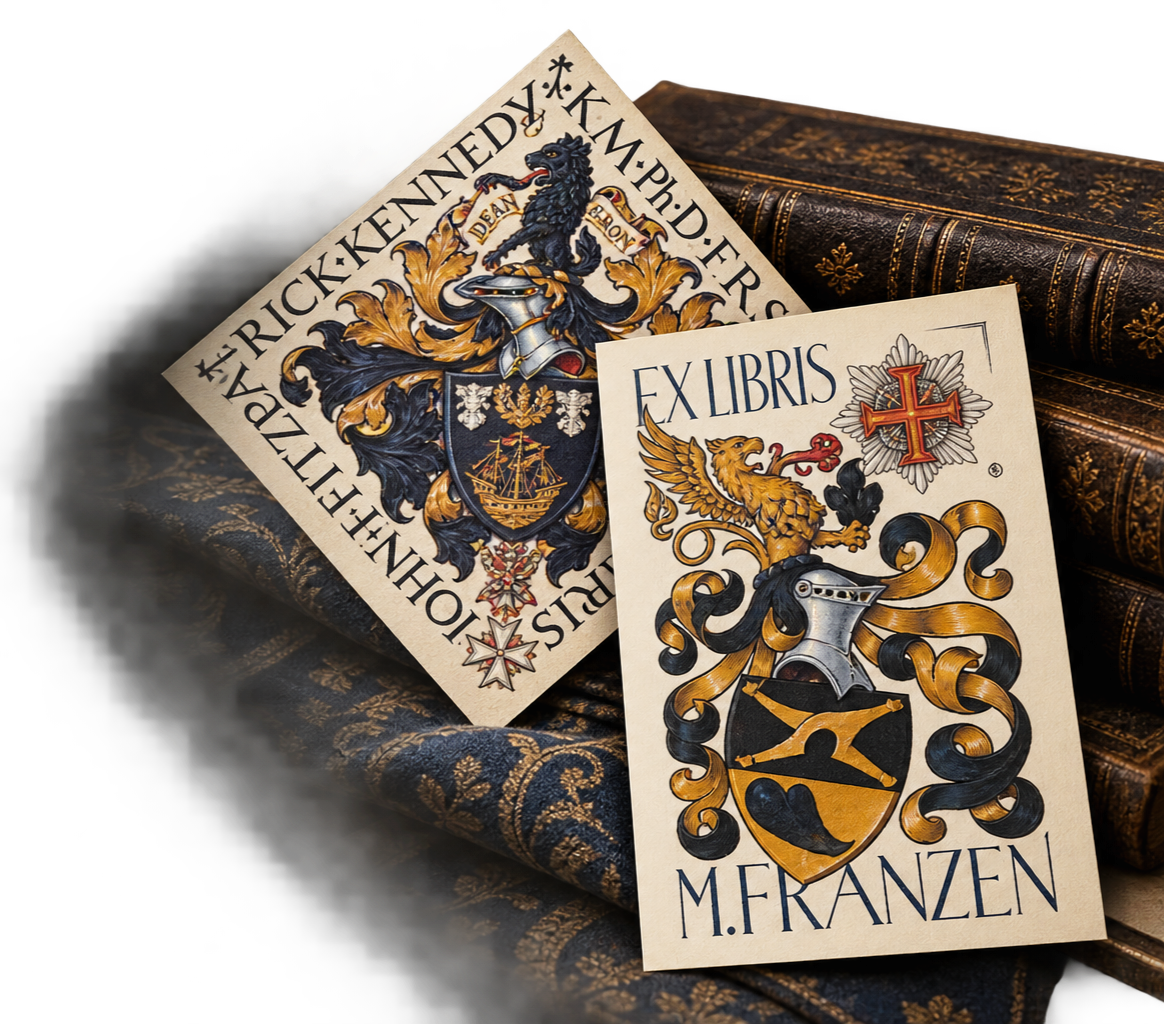
While the historic bookplate belongs naturally to the world of the private library, the tradition did not disappear with the passing of the great age of engraving. Heraldic bookplates continue to be commissioned, drawn and collected today, carrying forward many of the same ideas of identity, ownership and personal symbolism in a distinctly modern context.
The examples gathered here represent the work of a number of heraldic artists from Canada and abroad. Some are highly traditional in composition; others reveal a more individual hand. Together, they demonstrate the remarkable adaptability of the bookplate as an art form — capable of remaining rooted in heraldic convention while reflecting the character, taste and circumstances of its owner.
Many of these plates are associated with heraldists, artists, officers, academics and others closely connected with the wider heraldic world. Their designs offer an opportunity not only to consider the arms themselves, but also the individual artistic choices through which those arms have been interpreted.
Presented together, they form a small survey of the living tradition of the heraldic ex libris — one in which centuries-old visual language continues to find new expression.
Professor Antti Matikkala
Bookplate by Karl K. Laurla, c. 1999
Finnish heraldist, author and scholar of phaleristics
Sir Conrad Swan, KCVO, FRHSC
Bookplate by Robert Parsons (c. 1983)
Commissioned while service as York Herald
Sir Iain Moncreiffe of that Ilk, CVO, QC, KStJ, DL
Bookplate by Don Pottinger, c. 1960
Eduardo Esperança
Self-designed bookplate, c. 1984
Illustrator and heraldic artist.
James McCready
Self-designed bookplate, c. 1995
New Zealand heraldist and prolific designer of heraldic bookplates.
Sir Conrad Swan, KCVO, FRHSC
Bookplate by John Bainbridge, c. 1993
Canadian-born herald who served as Garter Principal King of Arms
Major-General Gilbert Monckton, 2nd Viscount Monckton of Brenchley, CB, OBE, MC, DL, FSA
Anthony Wood
Self-designed bookplate, c. 1974
Heraldic artist and illustrator.
Lieutenant Commander Michael J. Quigley, USN
Bookplate by Tudor Radu, c. 2013
Anthony W. C. Phelps
Bookplate by Geoffrey Mussett, c. 1970
Peter Harling
Bookplate by Andrew Stewart Jamieson
The Most Reverend Bruno Bernard Heim
Bookplate by Rudolf Niedballa, c. 1982
Archbishop of Xanthos and heraldic artist.
Jiří Louda
Self-designed bookplate, c. 1952
Czech heraldist and heraldic artist.

Unknown at this time
Henry Lyman Parsons Beckwith, Jr.
Bookplate by Hans D. Birk, c. 1970
Sir Alexander Colin Cole, KCVO, TD, OStJ
Bookplate by Zdenko G. Alexy, c. 1982
Garter Principal King of Arms.
Vintage Bookplates
Fragments of Lives, Libraries & Provenanc
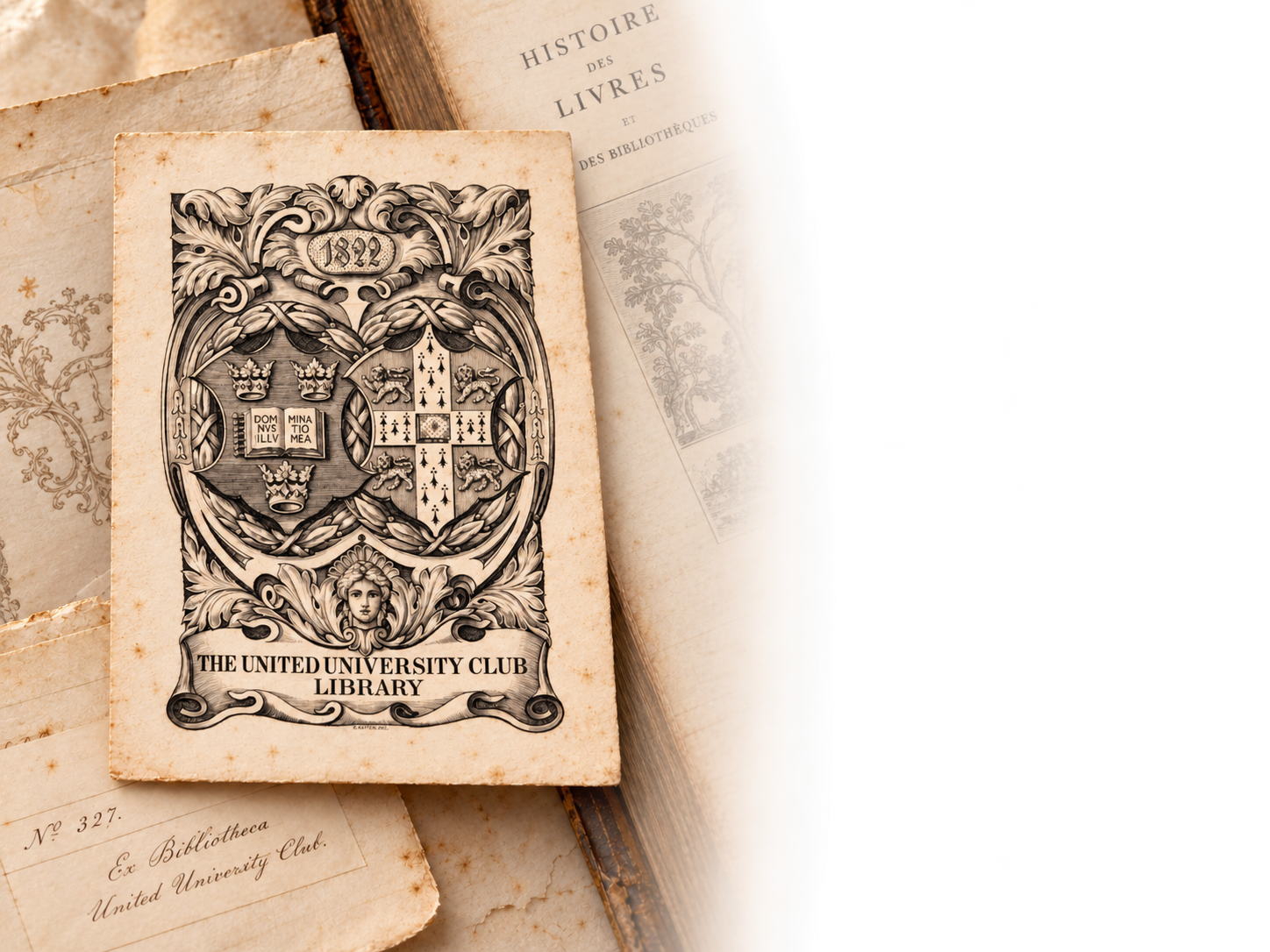
There is a particular intimacy to an older bookplate. Each one once belonged inside a real book, in a real library, and to a person who chose to leave some small expression of identity upon the volumes they valued. Long after those libraries have been dispersed — and often long after the names themselves have faded from common memory — the bookplate remains.
For the collector, this is part of their enduring fascination. A coat of arms may reveal lineage; a coronet, mitre or decoration may speak to office or distinction; a motto may suggest something of character or aspiration. Names once associated with military service, scholarship, public life, the Church, the aristocracy or the great institutions of their day survive here in miniature, attached to books that passed through their hands.
These older examples also preserve something of the age in which they were made. The engraver’s line, the changing treatment of heraldry, typography and ornament, even the choice between restrained simplicity and elaborate display, all reflect evolving ideas of taste, status and personal identity.
The plates gathered here span several generations and traditions. Some belonged to figures readily remembered; others offer only tantalising fragments of lives now largely forgotten. Yet each has provenance. Each once marked a place within someone’s library.
That, perhaps, is what gives the vintage bookplate its particular appeal: it is not merely an image of arms on paper, but a surviving witness to a person, a collection, and a world that once surrounded the books they chose to keep
Lieutenant-General Sir James Adolphus Oughton, KB
Armorial bookplate, c. 1770
Commander-in-Chief in Scotland and former Grand Master of the Grand Lodge of Scotland.
Sir Thomas North Dick-Lauder of Fountainhall, 9th Baronet
Armorial bookplate, c. 1882
Knight of Justice of the Order of St John of Jerusalem
Charles Moore, 1st Marquess of Drogheda
Armorial bookplate, c. 1810
Field Marshal in the British Army.
Lieutenant-Colonel Sir William Topham, KCH
Armorial bookplate, c. 1860
Member of the Honourable Corps of Gentlemen at Arms.
James Archibald Stuart-Wortley, PC, QC
Armorial bookplate, c. 1830
Barrister and British parliamentarian who served as Solicitor General
William Cavendish-Bentinck, KG, CVO,
6th Duke of Portland
Armorial bookplate, c. 1900
Sir George Augustus William Shuckburgh-Evelyn, 6th Baronet
Armorial bookplate, c. 1790
Mathematician, astronomer and public figure.
The Right Reverend John Douglas, DD, FRS, FSA Episcopal bookplate, late 18th century Bishop of Salisbur
The Most Reverend Charles Brodrick, Archbishop of Cashel
Episcopal bookplate, c. 1810
Thomas Le Blanc, FSA
Armorial bookplate, c. 1815
Master of Trinity Hall and Vice-Chancellor of the University of Cambridge.
John Conduitt, Esq.
Armorial bookplate, c. 1730
Master of the Royal Mint, 1727–1737
Sir Mayson Moss Beeton, KBE
Armorial bookplate, c. 1921
President of the Anglo-Newfoundland Development Company and wartime Director of Timber Supplies.
James Charles Dale
Armorial bookplate, c. 1843
English naturalist and High Sheriff of Dorset
Frederick Waymouth Gibbs
Armorial bookplate, 19th century
Barrister and tutor to the future King Edward VII and Prince Alfred
HRH Prince Augustus Frederick,
Duke of Sussex
Armorial bookplate, c. 1827–1843
The Right Honourable Sir Robert Laird Borden, GCMG, PC, KC
Armorial bookplate, c. 1915
Eighth Prime Minister of Canada, 1911–1920