Art Deco & the Geometry of Grace
Entry No. 30
Dear Faithful Companion,
There is something about the geometry of grace—the way bold lines and glimmering accents from a century past can settle into a room and make it feel both rooted and radiant. When we first crossed the threshold of this house, I knew it required a front sitting room not simply to fill space, but to make a statement. A chamber of reception and repose. One touched by glamour, yet not overwhelmed by it. One that shimmered with history, but refused to feel dated.
I have long harboured a fondness for the rich bravado of the Art Deco era. That heady blend of emerald greens, polished woods, brushed golds, and crisp geometries—the visual rhythm of a Charleston beat rendered in velvet and brass. The era brings with it the mystique of Bond and the hedonistic sparkle of Gatsby, a world where even a cigarette lighter was an object of design.
So it was that when Jesse and I envisioned this sitting room, we aimed not just for aesthetic beauty, but for atmosphere. To be fair, the vision was more mine than his—but he was graciously game for the adventure. And now that the room has fully come into its own, he’ll be the first to admit that the finished product delights him just as much.
Masculine elegance guided our hand, yes—but it was comfort and character that shaped the soul of the space. I wanted it to speak without shouting, to offer both gravitas and welcome. A place one could enter with a cocktail or a conversation and feel entirely at ease—yet distinctly aware that this was no ordinary room.
The avocado green velvet chesterfield became the anchor—its colour unexpected, yet oddly familiar, like an heirloom freshly unwrapped. Its bold hue offered just the right touch of audacity, while its plush texture softened the room’s symmetry. Around it, the rest of the space began to align: the geometry, the palette, the mood. It became less a piece of furniture and more a declaration—that glamour and comfort need not be mutually exclusive.
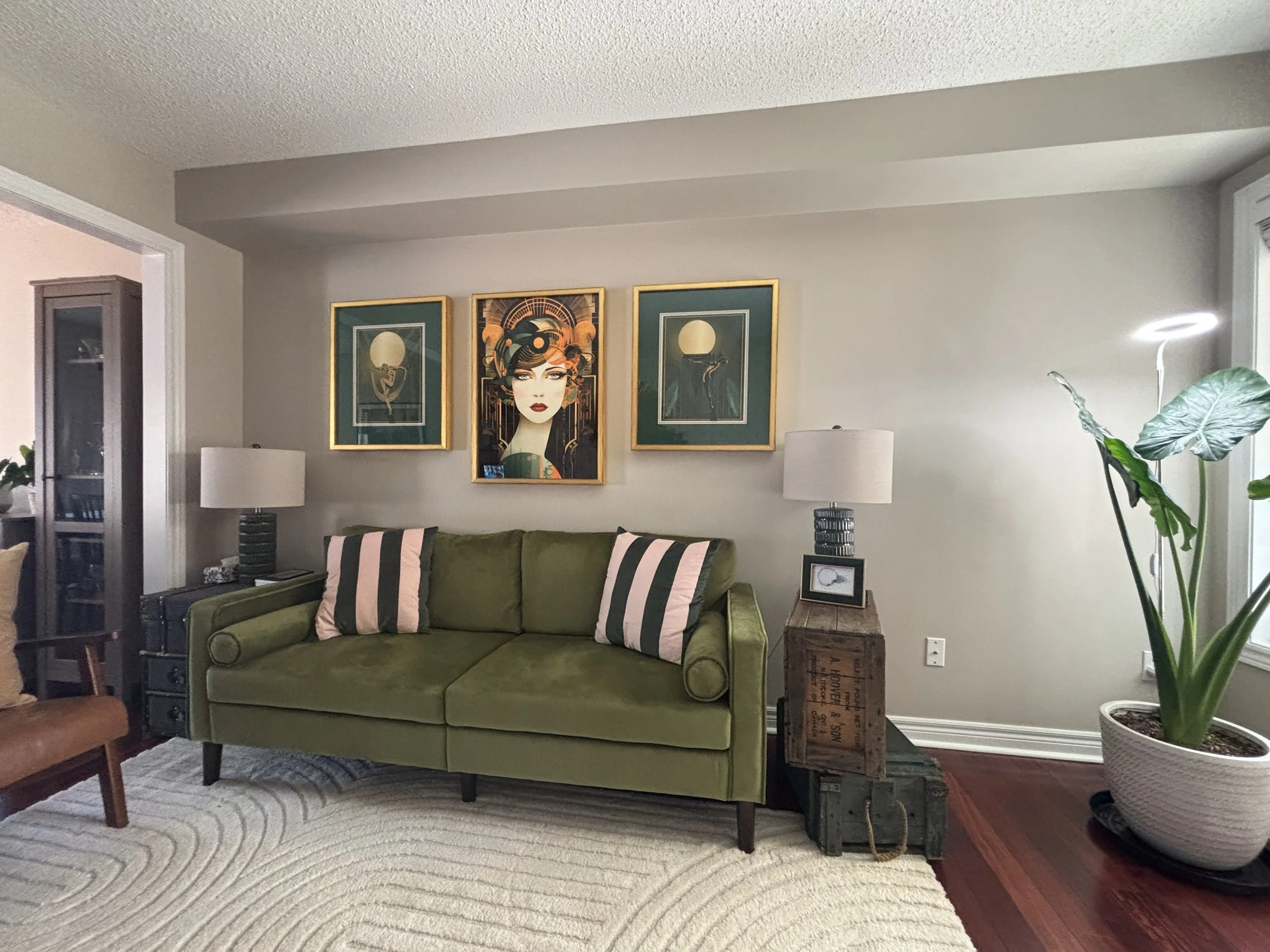
Behind it, the artwork was carefully curated from afar. The bold, stylized face of a Deco-era woman now holds court from the centre of the wall—silent, striking, and effortlessly composed. She is flanked by sharp silhouettes that echo the lines of the era, all framed masterfully in gold and green by Michaels. Her gaze commands the room, imbuing it with a kind of dignified charm that feels both nostalgic and fresh.
The raven lamp perches with Poe-like poise, casting moody shadows that dance across the lighter woods of the low-slung chairs. At times, the room evokes the sitting saloon of RMS Britannia—where soft voices, polished brass, and maritime restraint shaped quiet conversations on the open sea. This room now holds the same invitation: pause, reflect, speak freely.
Even the walls carry the weight of intention. My first foray into wallpapering—bold Deco fans unfurling in soft arcs across the room—was a labour of both learning and precision. It tested patience and revealed a quiet pride. Not perfection, but personality.
One of my favourite elements is a shelf, discreet yet deliberate. It is never static. When guests arrive, it might feature a souvenir from a recent trip, a letter of note, or something curated to speak to their interests. Its purpose is not just decorative, but conversational—a revolving vignette of our lives that invites curiosity, storytelling, and connection.
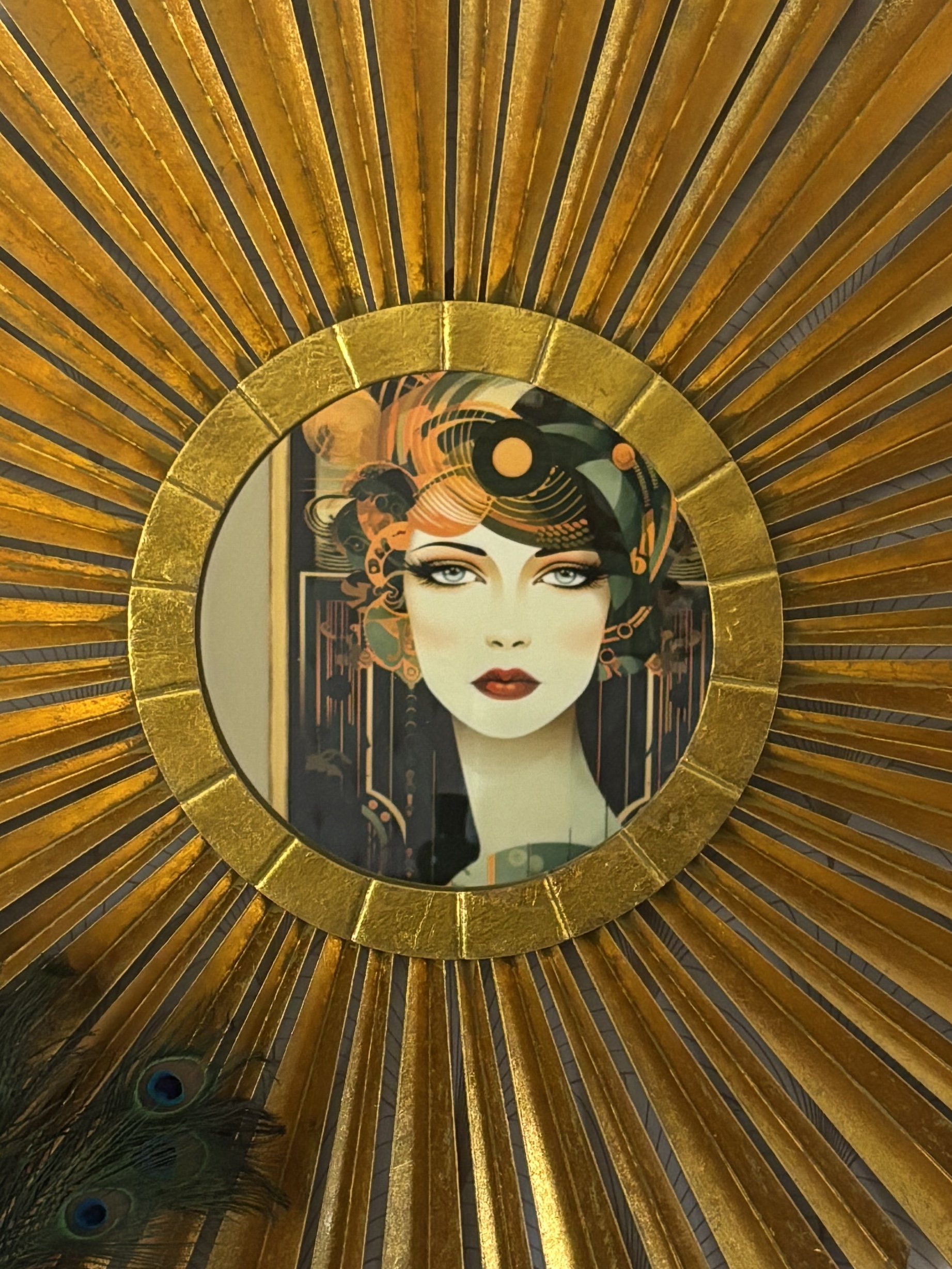
And then, the rituals: a candle flickering on the credenza, a glass of Bordeaux or Malbec in hand, and the warm cadence of jazz—perhaps “I’m Glad There Is You” by Chet Baker—floating softly from the HomePod discreetly tucked behind the cabinetry. There is no television here. None is needed. This is a room for conversation with depth, or for sitting in stillness, letting the light from the sunburst mirror scatter softly across the ceiling like a celestial dial.
As the designer Juan Montoya once said,
“A room should never allow the eye to settle in one place. It should smile at you and create fantasy.”
Indeed, this room was not created merely to impress—it was made to smile back. To awaken memory, to ignite dialogue, and to invite both guests and hosts to linger longer than planned.
Verbum Ultimum
What began as a décor project became a quiet manifesto—a declaration that elegance need not whisper, and that structure can contain warmth. A gentleman does not simply decorate a room—he curates atmosphere, anchors memory, and sets a stage for meaningful moments to unfold. The walls may gleam and the furnishings impress, but the true art lies in how a space makes one feel—heard, welcomed, at ease.
To build such a room is to understand that hospitality is a form of grace, that taste is most refined when it reflects not wealth, but character. And above all, that every object chosen with care becomes a mirror not just of style, but of self.
Here, in this little geometry of grace, we have found not just a room—but a reflection of the life we are shaping within it.
Until next we write, I remain
JCB